
Can You Install Electric Floor Heating Over an Existing Floor? A Complete Subfloor & Surface Guide
Yes, electric underfloor heating can be installed over most existing subfloors and some existing finished floors, provided the surface is structurally sound, properly prepared, and the correct installation method is used. Concrete slabs, plywood, cement backer board, existing tile, and some vinyl floors can all be suitable substrates, although each requires different preparation before the heating system is installed.
| Existing surface | Can you install over it? | Preparation requirements |
| Concrete slab | ✅ Yes | Insulation boards recommended |
| Plywood | ✅ Yes | May require insulation boards if over a crawl space or unheated area |
| Existing tile | ✅ Yes (with preparation) | Clean, level, bonded properly |
| Durock/Hardie backer board | ✅ Yes | Embed cables in thinset or self-leveler |
| Existing sheet vinyl | ✅ Yes (with preparation) | Prime, level, or install insulation boards |
| Carpet or carpet pad | ❌ No | Remove completely |
Installing electric floor heating over a concrete slab
Installing an electric floor heating system directly over a concrete slab is possible, however, it will affect the heat-up times and overall efficiency of the heating system. Without a thermal break, the concrete acts as a heat sink, meaning heat is absorbed by the slab before warming the finished floor and the room above.
For this reason, Warmup recommends installing an Insulation Board over a concrete subfloor to act as a thermal break. This helps the heat to radiate upwards first, rather than down into the slab, reducing heat-up time by over 70% and decreasing heat loss by over 90%. Without floor insulation, the heating system will still function properly, but it will take longer to reach its target temperature.
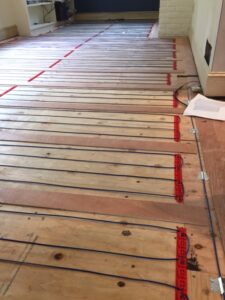
Installing electric floor heating over a plywood subfloor
Plywood is a good substrate for electric floor heating because wood is an insulator, helping direct more heat toward the finished floor instead of into the subfloor.
Insulation Boards are not required for an installation over plywood unless the space below is a crawl space or unheated area, however, using Insulation Boards will still improve system performance. If the installation area is over an unheated crawl space or garage, using insulation boards will help to prevent heat from escaping downwards into the colder space below.
Before installing an underfloor heating system over plywood, ensure that the subfloor is smooth, dry, and free of dust and check that there are no objects on the subfloor that might damage the heating element.
Installing electric floor heating over a cement board (Durock or HardieBacker)
Underfloor heating products can be installed directly over a cement board (such as Durock or HardieBacker). Cement board works well and is commonly recommended for underfloor heating installations because it is:
- Moisture resistant
- Dimensionally stable
- Commonly used beneath tile
- Compatible with thinset
After preparing the installation surface and laying the heating element, the cables must be embedded in a thinset or self-leveler.
Installing electric floor heating over existing tile
Installing underfloor heating over an existing tile floor is a practical substrate option because it eliminates the need for demolition while providing a stable surface for the new heating system and flooring. Floor heating can be installed over existing tile under the following conditions:
- The tile is firmly bonded
- There are no loose tiles
- The flooring is structurally sound
- The tiles are cleaned, degreased, and primed
Existing tile can often remain in place if it is securely bonded, which can reduce demolition time and installation costs. Tiles that are cracked, loose, or hollow sounding should be repaired or replaced before installation.
Installing electric floor heating over existing vinyl flooring
Ideally, existing vinyl flooring should be removed before installing a radiant heating system over it.
However, with proper preparation, an underfloor system can be installed over a vinyl floor when necessary. The vinyl may interfere with adhesion if it is loose or flexible; proper surface preparation is critical. In this instance, Warmup recommends:
- The vinyl is firmly bonded
- The surface is primed
- A self-leveler is used
- Installation board is installed (as needed)
Surface preparation checklist
Before installing electric underfloor heating (no matter what the subfloor or installation surface is), make sure the surface is:
- Structurally sound
- Dry
- Clean
- Level
- Securely bonded
- Free of debris, dust, or dirt
- Compatible with the finished flooring
- Approved by the flooring manufacturer